
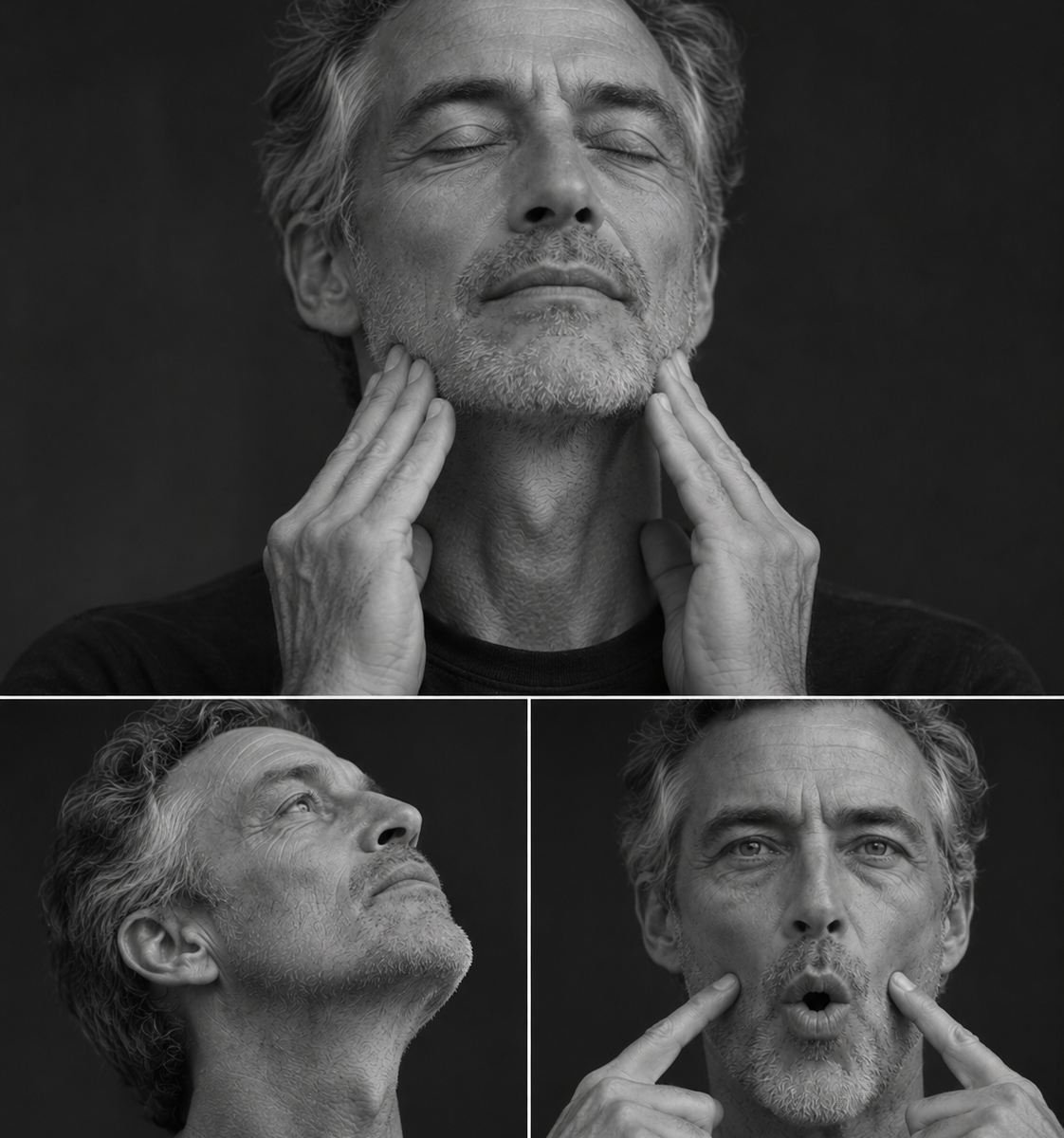

Face yoga is everywhere on social media, where it promises a knife-free lift in a few minutes a day. The idea is in fact very old, and it rests on a simple anatomical truth: the face is made of muscles, and a muscle needs upkeep. I wanted to share with you what these exercises bring, where they come from, and why, on a face, how you do them matters as much as the effort.
Face yoga and facial fitness, two cousins
We often use the two terms interchangeably, though they do not say quite the same thing. Face yoga is slow and holistic: it blends gentle exercises, massage, acupressure, breathing and the release of tension. You tone as much as you soothe (Fumiko Takatsu brought Face Yoga to the fore from 2006, as did Danielle Collins). Facial fitness is more athletic: targeted strengthening exercises, with repetitions and resistance, like a workout for the face (Senta Maria Runge and her Face Lifting by Exercise in the 1960s, Eva Fraser and her Facial Fitness). And long before them, facial exercises already existed in Ayurveda in India, Qi Gong in China, and among Japanese geishas. Both practices work the same muscles, which is why they get confused, but the spirit is not the same.
What the science really says
The benefit is real, but modest. The only serious study, led by Alam and colleagues in 2018, followed sixteen women for twenty weeks, at thirty minutes of exercises a day: by the end, the cheeks were a little fuller and the face judged about three years younger.1 A review of the existing work remains cautious, for lack of solid studies.2 And there is a limit I want to share with you, because it changes how you go about it: fast, pressing movements, repeated always in the same spot, end up carving the skin. It is the very mechanism of the frown line or the crow's feet, where an expression that keeps coming back slowly etches itself. The muscles of the face attach directly to the skin, and contracting them hard and fast means creasing it again and again. Hence a paradox dermatologists know well: rushed, these exercises can mark the face rather than smooth it.
Slowness, the real key
That is why I love a slow, gentle practice. Precise movements, never grimaces. A light resistance from the fingers, so the muscle works without pulling on the skin. And regularity, a few minutes each day rather than one long session now and then. You dwell on the areas that matter, for men as for women: the lower face and the jaw, the neck and its broad muscle, the platysma, the eye area with great delicacy. Seen this way, face yoga looks less like a sports session than a moment of care: you tone and you soothe in the same gesture.
These gestures, I pass them on in person, hand in hand, in my self-massage and face-yoga workshop. You learn better together than behind a screen. Book your session.
Frequently asked questions
Can face yoga replace a facelift?
No. It tones the muscles and can lift a little, but it acts neither on the bone nor on the fat that change with age, and it does not erase a line that is already there.
Can these exercises mark the skin?
Yes, done fast and forcefully, repeating the same grimaces: repeated expressions etch themselves, like the frown line. That is exactly why slow, controlled movements matter.
How long before you see a result?
With regularity and patience. The only solid study required twenty weeks of near-daily practice for an effect judged modest.