For a few months now, cortisol has been everywhere: cortisol face, cortisol cocktail, sticking your tongue out to flush it out, ice baths, anti-cortisol routines. It gets blamed for the puffy face, the fatigue, the extra pounds, the wrinkles. Cortisol is very real, and it does matter for the skin. But between the science and the trend lies a world of difference. Let's sort through all of it.
What cortisol really is
Cortisol is our main stress hormone, secreted by the adrenal glands under the control of the brain-pituitary-adrenal axis. It follows a rhythm: high in the morning, to get us going, low in the evening, to let sleep come. In the short term it is useful, it makes us sharp and reactive. The problem is not cortisol itself, it is its chronic presence: when stress never subsides, levels stay high around the clock. And that is when the effects build up, on the body and on the skin.
The skin, yes; the cortisol face, no
On the skin side, the link is real, but not the one people imagine. Chronically high cortisol weakens the skin barrier, slows its repair and eats away at collagen: this is the brain-skin axis, described by Chen and Lyga in 2014, and already observed in 2001 in the repair speed of stressed skin. The result: a duller complexion, more reactive skin that ages a little faster. That much is true.
What is false is the cortisol face, that suddenly round, puffy face said to appear after one stressful week. Dermatologists are clear: everyday stress does not raise cortisol strongly enough, or long enough, to change the shape of a face. The true moon face does exist, but it belongs to Cushing's syndrome, a rare condition linked to medication or a tumour, not to a busy week. Morning puffiness usually comes from lack of sleep, salt, alcohol.
The social-media tips, under scrutiny
There is no end to anti-cortisol tricks online. Let's sort them. Sticking your tongue out for thirty seconds? No. No study shows it, and cortisol depends on the brain-adrenal axis, not on the tongue. The real core behind that gesture is the Lion's Breath, tongue out and a long exhale: what soothes is the slow breath, not the tongue.
Slow breathing, meditation, yoga? Yes, and that is what has the most evidence: a 2024 meta-analysis confirms the effect of mind-body practices on cortisol, with yoga leading. Conversely, very intense efforts such as HIIT tend to push it up. Ice baths and cold showers? To be qualified: in the moment, cold raises cortisol, it is a stress for the body; the soothing effect, if any, comes later, and the data remain thin. It is not the miracle solution you are sold.
Ashwagandha? This is the most serious lead among supplements. A 2012 trial, on a standardised extract of 600 mg a day for two months, measured a drop in cortisol of about 28% in highly stressed people. A caveat: the studies are small, often funded by manufacturers, and the effect mainly concerns the chronically stressed. Magnesium, which many of us lack, also supports the nervous system; Nutri&Co offers both, as an adaptogen and as magnesium, though medical advice remains sensible, especially if you are on medication. The cortisol cocktail to drink? Hydration and electrolytes, nothing more: no evidence of any effect on cortisol. Cutting caffeine and sleeping better, on the other hand, genuinely help.
And touch
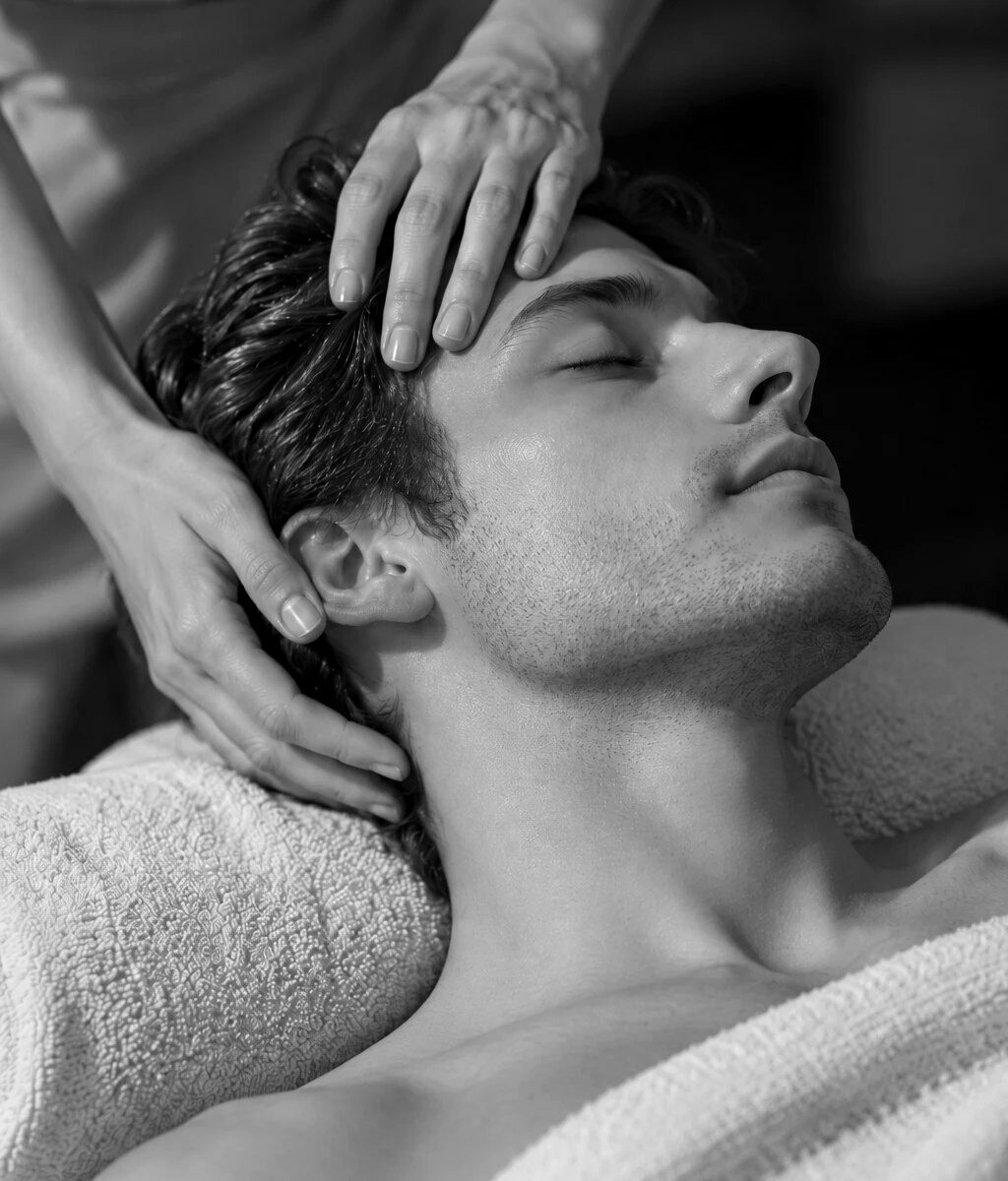
Then there is touch. Massage lowers salivary cortisol, Shimada showed it back in 2013 on the scalp, confirmed in 2016. This is exactly what I do in the studio: massage drains, decongests and stimulates lymphatic circulation, the skin's own way of clearing itself; and in the same movement, it releases nervous tension. Cortisol itself is not flushed out like a toxin, but it falls when the body settles. Less cortisol means skin that breathes, deeper sleep, a rested face. Not a seven-day miracle, a balance you keep up.
This release is what I work on in Récupération for men and La Parenthèse for women, the treatments that truly soothe.
Frequently asked questions
Does stress really cause a puffy face?
Not everyday stress. Passing puffiness comes mostly from lack of sleep, salt or alcohol. A lastingly round, bloated face is a matter for medical advice, not a trend.
Does sticking your tongue out lower cortisol?
No, no study shows it. What soothes is the slow breathing that accompanies the gesture, not the tongue itself.
Does ashwagandha work?
There is a real signal in highly stressed people, but the studies are small and often funded by manufacturers. Medical advice is recommended, especially if you are on medication.
References
Chen, Lyga, Brain-Skin Connection, 2014. Altemus et al., stress and the skin barrier, Journal of Investigative Dermatology, 2001. Meta-analysis of stress-management interventions on cortisol, Psychoneuroendocrinology, 2024. Network meta-analysis of exercise and cortisol (yoga, qi gong), 2024. Chandrasekhar et al., ashwagandha KSM-66 and cortisol, Indian Journal of Psychological Medicine, 2012. Shimada et al., scalp massage and cortisol, 2013. Journal of Physical Therapy Science, 2016.