Autumn announces itself, taking up residence as early as September 21, and the skin senses it before the calendar does: the sun withdraws, the air turns dry, the heating resumes its rights and the pace quickens, until that morning when the face feels tight and the complexion has lost its light. The temptation would be to strip everything away and start from scratch; that is precisely where we go wrong. Skin worn by the season does not ask to be scoured, but to be nourished and protected. On this ground, two gestures are worth more than a shelf of bottles: the mask, and the hand.
The mask, and the serum it seals in
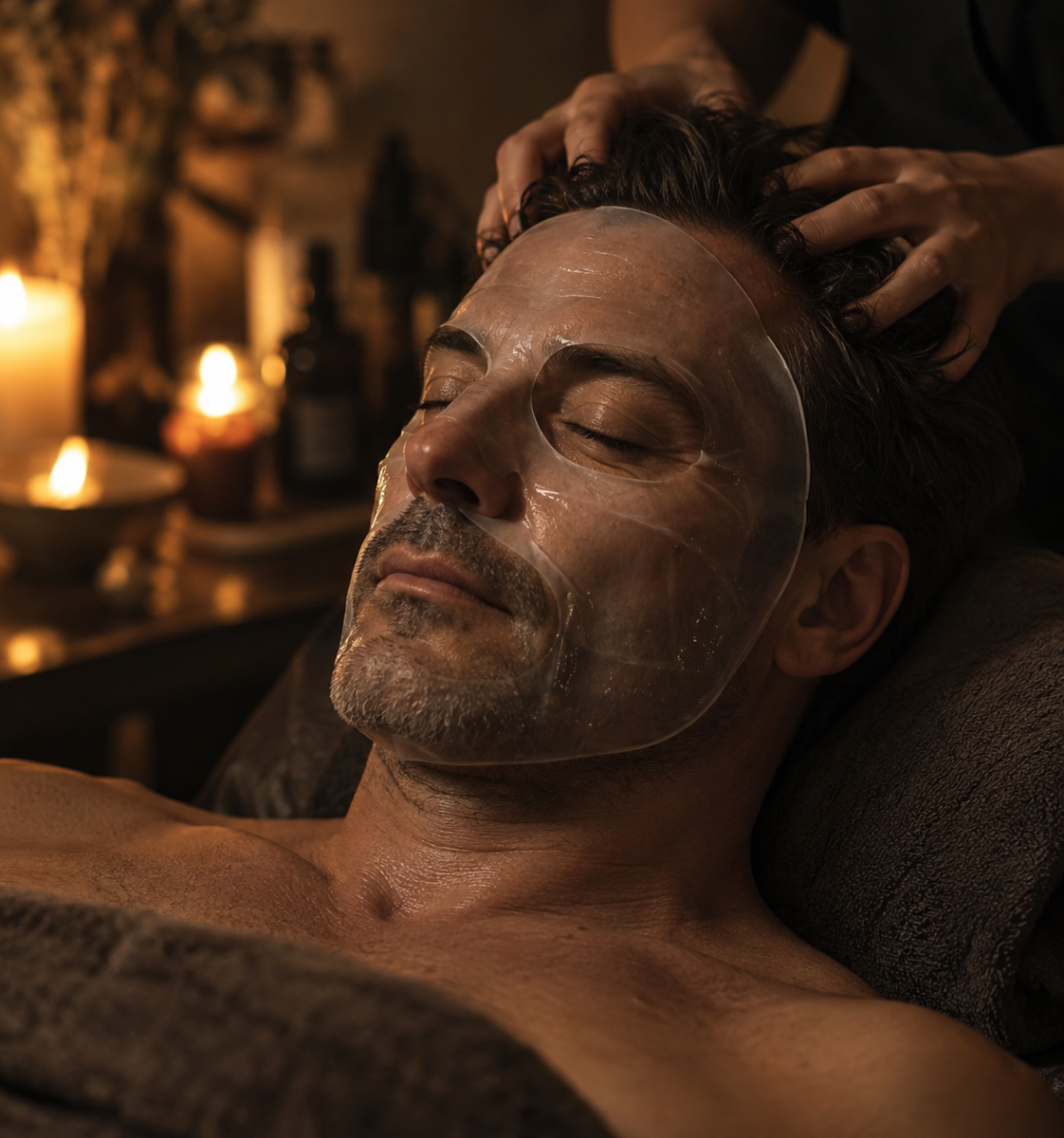
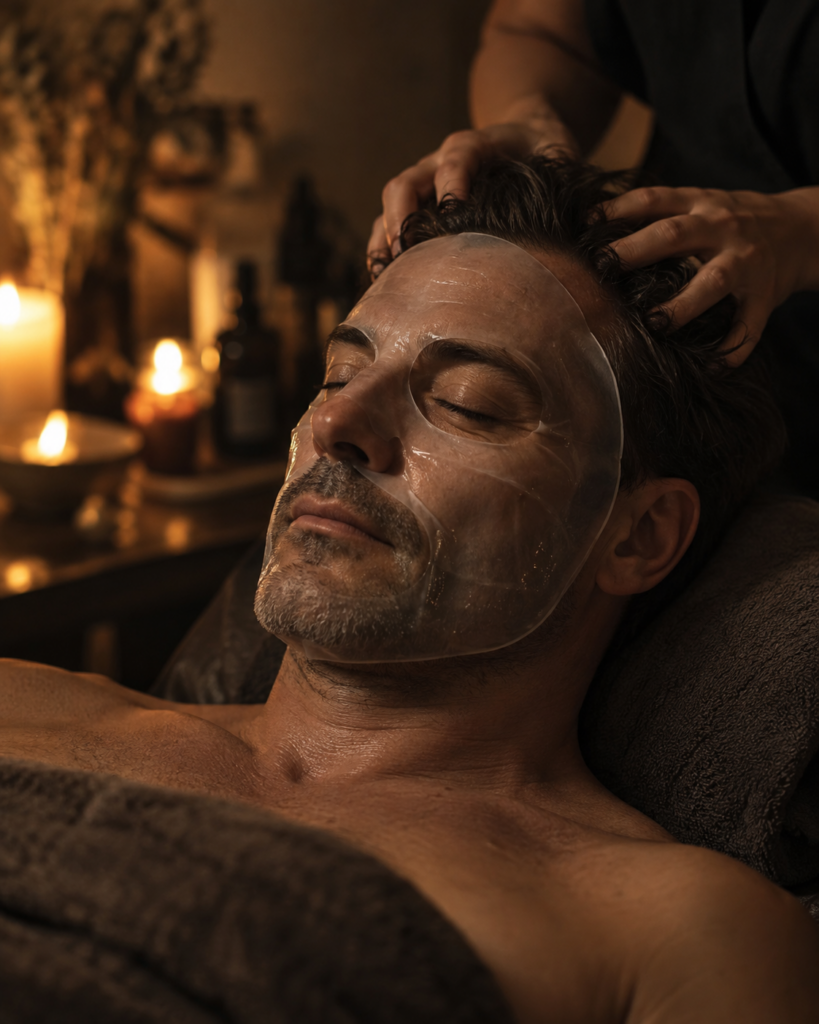
Of all the masks, only one truly works in depth: the occlusive one, the one that seals. The gesture is soon told. First you lay down a serum, concentrated and chosen for what the skin needs that evening, then you seal it beneath a reusable silicone mask. Silicone, on its own, brings nothing; but the airtight film it forms hydrates the stratum corneum and carries the active deeper still, occlusion increasing the penetration of many active ingredients, as science has established.1 A quarter of an hour, and the serum gives its full measure, where, applied alone, it delivered only a part. Fine ones can be found at Typology or The Ordinary, and, for men, at Horace or Bulldog. Clay, for its part, pursues the opposite design, absorbing sebum and drying to unclog oily skin, so that a rich serum slipped beneath it would make no sense.
Yet the mask, precious as it is, signs only a glow, real but fleeting: truly rebuilding the barrier takes weeks of regular care, not the span of an evening. We devoted a whole Carnet to it at the end of summer.
The plate, too, changes with the season
Radiance is also nourished from within, and the autumn plate bears little resemblance to the summer one. We set aside raw vegetables and water-heavy fruit for a denser, more colourful table: squash and sweet potato, whose beta-carotene warms the complexion, beetroot, the last figs and grapes brimming with antioxidants, walnuts and their good fats. Nothing compulsory, but skin nourished from within weathers the turn of the seasons better.
The hand that doubles the mask
The mask, through its occlusive film, does carry the actives in; but it does not revive circulation, does not drain, unknots no muscle. That is where the hand takes over, and it is my craft. Under its pressure, the face awakens: the vessels release nitric oxide, dilate, blood flows in, bearing oxygen and nutrients, and the complexion revives within the hour. The same gesture rouses the lymphatic drainage, that pumpless network that moves only at the fingers urging, and lightens features the new season had weighed down. It finally loosens those muscles that stress locks without our knowing, the jaw, the temples, the brow. A recent clinical trial even measured it: in women devoted to gua sha, regular massage redrew the contour of the face and eased muscle tone.2 The division is limpid: at home, one nourishes and covers; in the treatment room, I massage, I drain, I release, for a full hour. Far from replacing one another, the two gestures answer each other. Book the Récupération for men, or La Parenthèse for women, and leave to the hand what no mask will ever do.
1 Zhai H, Maibach HI, Effects of Skin Occlusion on Percutaneous Absorption: An Overview, Skin Pharmacology and Applied Skin Physiology, 2001.
2 Ahn et al., Comparative Effects of Facial Roller and Gua Sha Massage on Facial Contour, Muscle Tone, and Skin Elasticity: Randomized Controlled Trial, Journal of Cosmetic Dermatology, 2025.