
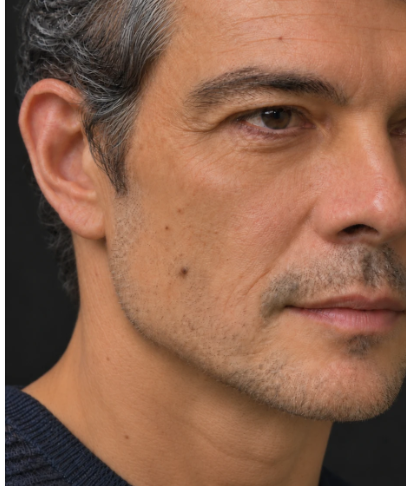
We clench our teeth without noticing: in front of a screen, stuck in traffic, and at night most of all. In the studio, I feel it right away, these jaws that never let go, hard under the fingers. It's one of the places where stress settles most quietly, and one of those that changes the lower face the most. I wanted to tell you about it: what happens when the jaw tightens, the massage I practise to release it, what a night guard fixes and what it doesn't, and how to loosen all this at home.
Bruxism, the stress that drops into the jaw
Clenching or grinding the teeth has a name, bruxism, and it covers two things. Clenching, when you lock the jaws without moving, silent, mostly in the daytime. And grinding, when the teeth rub against each other, noisy, mostly at night, in a rhythmic way. The international consensus by Lobbezoo, in 2018, brings them together under this name and distinguishes awake bruxism, more about clenching, from sleep bruxism, more about grinding.1
Behind this lies the whole masticatory apparatus at work: the masseter, the temporalis over the temple, and the two pterygoids, medial and lateral, nestled deeper. But the one you see is the masseter, the muscle that closes the jaw, the most powerful of the group for its size and the most superficial. Worked without rest, it thickens like an over-trained muscle: the lower face widens, squares off, the jaw angle juts out. Added to this are tensions that climb toward the temples, where the temporalis pulls, sometimes headaches on waking.
The intra-oral massage, my way to release it
The treatment I practise most on this area is the intra-oral massage, and it's also the one that changes the jaw the most. It means working the masseter from inside the cheek, a gloved finger pressed against the muscle, where it's thickest and hardest to reach otherwise. From outside, you glide over it; from inside, you really hold it. I work slowly, in presses and stretches, to undo knot after knot a tension that has settled over months. The first seconds surprise, the area is often sore, so contracted it is, then the muscle gives, lengthens, and the jaw regains its range.
And contrary to what you often read, I don't work dry: with the mouth open, the mucosa dries out fast, and for an already dry mouth, a smoker or someone on medication, it's worse. A dab of food-grade oil, safe to swallow, makes the gesture far more comfortable. I like plum kernel oil, culinary and faintly almond-scented, but coconut or sesame oil do the job just as well.
The evidence points the same way: a review by Armijo-Olivo, in 2016, concluded that manual therapy and exercise reduce pain and improve the function of the jaw muscles.2 What I see in the studio confirms it: a long-worked jaw loosens, the lower face relaxes, the oval softens. Often, men discover at that moment how much they were clenching without knowing.
The night guard, and what happens at the dentist
Massage relaxes the muscle, but it doesn't protect the teeth from wear. If you grind at night, that's the role of the night guard, a thin clear plate moulded to measure that you wear while sleeping. It doesn't cure bruxism, it cushions the two jaws: the teeth slide instead of clashing, the enamel wears less, and morning tensions often ease. It's the dentist who assesses it, makes it and adjusts it, because protecting the enamel and the joint is their field. I say it plainly: for the tooth and the guard, you see the dentist; for the muscle and the release, that's me. The two go together, one protects, the other unknots.
Loosening the jaw at home
Between treatments, you keep the jaw more supple with a few simple habits. The one I repeat most: lips together, teeth apart. At rest, the teeth shouldn't touch, and becoming aware of the moments you clench, in the car, in front of the screen, already changes a lot. You can massage the masseter from outside, with your fingertips, in small slow circles, after the shower when the muscle is warm. Caring for your posture at the screen helps too.
But a clenched jaw is, most often, a matter of stress, and it's the root you have to soothe: anything that calms the nervous system also releases the jaw. Relaxation, meditation, cardiac coherence all help, and for more guided support, a sophrologist or a hypnotherapist can do a lot, especially when the clenching is rooted in anxiety. Magnesium, which many of us lack, further supports muscular and nervous relaxation: the Anti-stress supplement by Care, a well-dosed bisglycinate, does the job. And once this ground is calmed, the intra-oral massage completes the work: it unknots the muscle from inside, where the tension has settled.
This jaw that never lets go, I work it in the studio: Récupération for men, La Parenthèse for women. Book your ritual.
Frequently asked questions
Can a clenched jaw widen the face?
Yes, over time. The masseter thickens when you clench constantly, and the lower face squares off. Releasing it regularly helps regain a softer line.
Is massage enough against bruxism?
It relaxes the muscle and eases the tension, which is precious. But if you grind at night, a dentist is still essential to protect the enamel, often with a night guard.
Does a night guard cure bruxism?
No, it protects the teeth from wear without making the clenching disappear. It combines well with releasing the muscle and working on stress.
Does magnesium help release the jaw?
It supports muscular and nervous relaxation, and many of us lack it. It's a supplement, not a treatment for bruxism.